





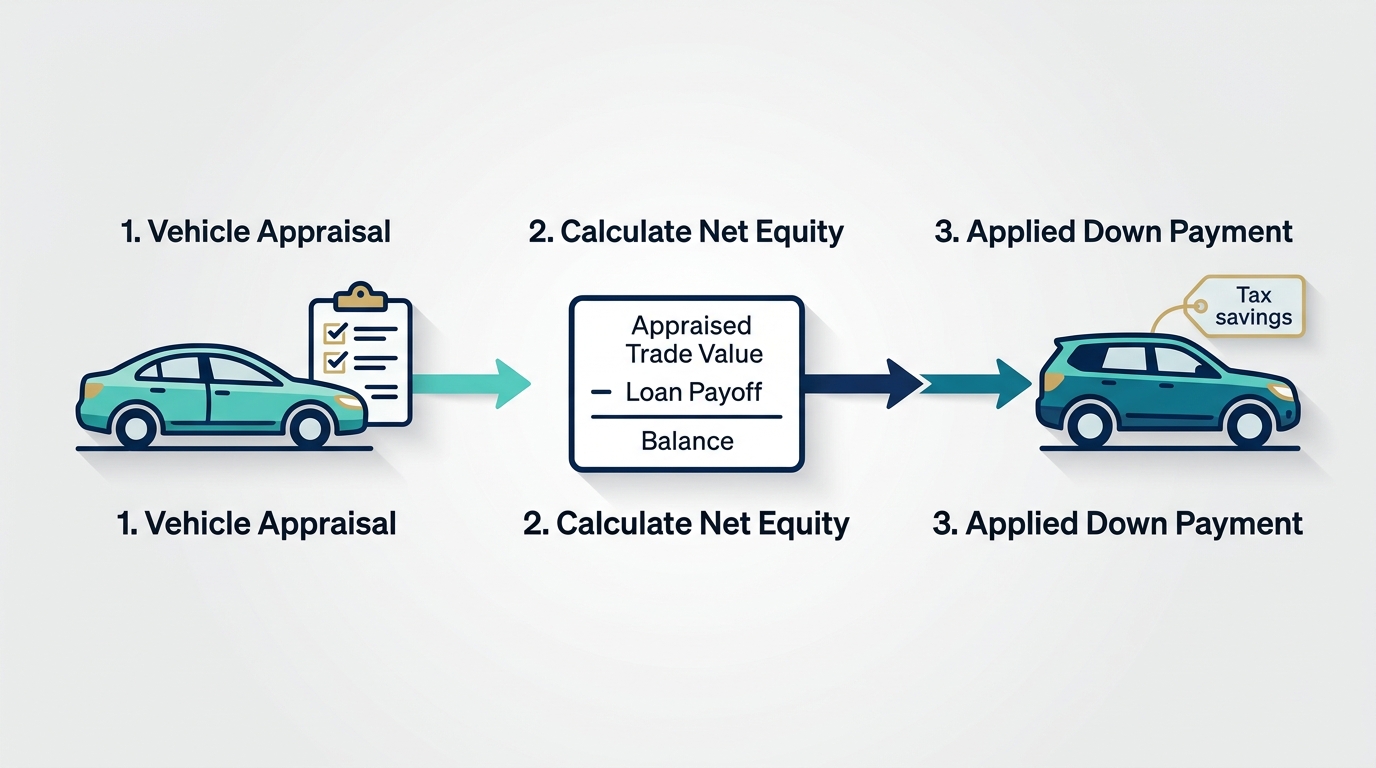
Trading in a vehicle at a dealership works by transferring ownership of your current car directly to the dealer in a single transaction, where its appraised wholesale value is credited toward the purchase price of your next vehicle. The dealer calculates your net equity by subtracting any outstanding loan payoff from the appraisal offer, applies that equity as a down payment, and manages all DMV title transfer paperwork on your behalf.
The entire trade-in process is structured to be completed during a single visit. When you bring your vehicle to our Wilmington showroom, an appraisal specialist inspects its mechanical condition, exterior body, interior wear, and vehicle history report. Once an offer is established, that trade allowance acts as direct purchasing power toward your new or pre-owned car.
For drivers who navigate the daily urban commute near the Christiana Riverfront, trading in locally offers a major financial benefit. In Delaware, the trade-in allowance is deducted directly from the new vehicle purchase price before calculating the mandatory 5.25% Delaware DMV document fee. Reducing the taxable price of your replacement vehicle lowers your out-of-pocket transaction costs compared to selling your vehicle independently. If you have questions before visiting, by giving our sales team a call allows you to review the initial steps before driving in.
Table of Contents
- How Does Winner Chevrolet Determine Trade-In Value and What Reduces It?
- Should You Fix Small Cosmetic Damage Before Trading In Your Car?
- What Is the First Step, Required Documents, and Loan Payoff Process?
- How to Maximize Your Savings with Trade-In Equity and Chevrolet Incentives
- Common Questions About Trading In Your Vehicle in Wilmington
- Take the First Step Toward Your Next Chevrolet at Winner Chevrolet
How Does Winner Chevrolet Determine Trade-In Value and What Reduces It?
Trade-in valuations are determined by combining live wholesale market data from resources like Kelley Blue Book and NADA Guides with a thorough physical inspection of your vehicle. Appraisers evaluate the vehicle’s year, make, model, trim level, current mileage, mechanical health, and regional buyer demand. Typical dealer trade-in values run about 10% to 20% below private-party retail estimates because the dealership assumes the cost of safety inspections, mechanical reconditioning, cosmetic detailing, and market protection before reselling the vehicle.
Several specific factors cause a vehicle’s trade-in value to decrease significantly during the appraisal:
- High mileage exceeding standard annual averages for the model year
- Prior accident history, frame damage, or structural body repairs
- Active warning lights, transmission slipping, or engine performance issues
- Excessive exterior dents, paint scratches, interior tears, or foul odors
- Missing service records indicating neglected factory maintenance
- Uneven tire tread wear or neglected brake components
Conversely, maintaining low mileage and keeping detailed service records can raise a vehicle’s trade-in offer by more than 30% compared to similar vehicles with incomplete maintenance histories. When evaluating a trade on our lot, our appraisers run a diagnostic scan for active engine fault codes, inspect mechanical components, and cross-reference real-time regional auction sales data to establish an accurate market value. To start your research from home, you can use our online trade-in evaluation tool before browsing our available pre-owned vehicle inventory.
Should You Fix Small Cosmetic Damage Before Trading In Your Car?
Minor cosmetic flaws do not require expensive body shop repairs before trading in your vehicle, as retail repair costs almost always exceed the incremental increase in trade-in value. Dealerships perform reconditioning and cosmetic reconditioning at wholesale internal labor and parts rates, meaning an appraisal deduction for a minor dent or bumper scuff is generally smaller than what a customer would pay out-of-pocket at a retail body shop. Spending hundreds of dollars on professional paint correction or collision repair rarely yields a dollar-for-dollar return on your trade offer.
Focus instead on low-cost preparation steps that improve presentation and demonstrate responsible ownership:
- Wash the exterior thoroughly and clean the wheels and windows
- Vacuum the cabin, wipe down dash surfaces, and remove personal belongings
- Fix inexpensive minor items, such as replacing a burnt-out headlight bulb or blown fuse
- Repair small windshield bullseye chips before they turn into full cracks
- Gather all maintenance receipts, original owner manuals, and spare key fobs
A clean, well-presented vehicle creates a strong initial impression during the physical inspection, assuring the appraiser that the mechanical components were likely well cared for as well.
What Is the First Step, Required Documents, and Loan Payoff Process?
The first step to trade in a vehicle is pulling an initial valuation estimate online and contacting your current lienholder to obtain an official 10-day payoff quote if you currently owe money on an active auto loan. This document states the exact remaining loan balance and daily interest charges required to pay off your account in full. Our finance team contacts your lender directly to confirm the balance and handles the check disbursement to satisfy the lien when finalizing your purchase.
When arriving at the dealership for your appraisal and trade-in transaction, ensure you bring the following required items:
- Physical vehicle title (if the car is owned outright without a lien)
- Current lender name, account number, and 10-day payoff quote (if financed)
- Valid driver’s license for every individual named on the vehicle title
- Current state vehicle registration card
- Valid proof of auto insurance
- All physical sets of keys, valet keys, and remote key fobs
- Complete vehicle maintenance records and service receipts
If your trade-in is appraised for more than your remaining loan balance, that positive equity acts as a cash down payment toward your replacement vehicle. If you owe more than the appraised market value (negative equity), the remaining balance can often be consolidated into your new auto loan, subject to credit approval. Completing an online credit pre-qualification form ahead of time helps our finance department structure your deal efficiently.
How to Maximize Your Savings with Trade-In Equity and Chevrolet Incentives
Maximizing your savings when upgrading your vehicle requires combining your trade-in equity with active factory customer cash allowances, promotional interest rates through GM Financial, and state tax benefits. Applying trade-in equity directly against the agreed purchase price lowers your total loan principal, which significantly reduces your monthly payment and overall interest costs over the life of the loan.
The state document fee savings in Delaware provides substantial value during a trade-in deal. Under Delaware House Bill 164, the DMV document fee is 5.25% of the vehicle purchase price. When trading in a vehicle through a licensed Delaware dealer, your trade-in allowance is subtracted from the purchase price before that fee is calculated.
For example, on a vehicle purchase of $40,000 with a trade-in allowance of $15,000, the taxable basis drops to $25,000. Applying the 5.25% rate to $25,000 results in a document fee of $1,312.50, compared to $2,100 without a trade-in—saving you $787.50 in tax-like fees alone.
For growing households making the daily suburban commute along the Route 40 corridor in Bear, combining these state fee savings with factory incentives on versatile three-row SUVs or light-duty pickup trucks keeps total vehicle ownership costs well within family budgets.
Common Questions About Trading In Your Vehicle in Wilmington
Q: Can I trade in a vehicle if the title has two names listed on it?
Yes, you can trade in a vehicle with joint ownership, but both individuals listed on the title must be present at the dealership to sign the official title transfer and odometer disclosure statements. If one title holder cannot attend the transaction in person, an official notarized power of attorney form authorizing the sale is required to complete the transfer legally.
Q: What happens if my trade-in equity exceeds the required down payment?
If your vehicle’s trade-in value is significantly higher than the loan payoff and exceeds the down payment required for your next purchase, you can apply the entire positive equity balance toward lowering the total purchase price. Alternatively, you can request to receive the remaining cash equity as a check from the dealership upon completing the sale.
Q: Do aftermarket accessories and custom modifications increase trade-in value?
Most aftermarket modifications, such as custom exhaust systems, aftermarket wheels, or lowered suspension setups, do not increase trade-in value and can sometimes lower it. Dealerships must recondition vehicles to meet broad resale standards, so factory original equipment and documented maintenance preserve trade value far better than non-factory alterations.
Q: How long is an in-person trade-in appraisal valid at Winner Chevrolet?
A physical trade-in appraisal conducted at our dealership is typically valid for 7 days or up to 250 additional miles driven, giving you adequate time to complete your research and finalize your financing details. This policy protects you against daily wholesale market fluctuations while you evaluate our new Chevrolet inventory.
Q: Can I trade in a leased vehicle from a manufacturer other than Chevrolet?
In most cases, leased vehicles from other brands can be traded in directly at our dealership, provided the leasing company permits third-party buyout transactions. Our finance department contacts the lease holder directly to obtain the current dealer payoff figure and process the lease buyout paperwork seamlessly.
Take the First Step Toward Your Next Chevrolet at Winner Chevrolet
Trading in your current car at Winner Chevrolet turns your vehicle’s value into immediate purchasing power through a fast, transparent transaction. Our team provides detailed market appraisals, handles all lender loan payoffs, and applies your trade-in credit to lower your purchase price and state document fees. Visit our Wilmington showroom location today or start the process by calling our sales team at (302) 267-4800 to schedule your professional trade-in appraisal.
Keep Your Vehicle Running Strong
Keep your vehicle performing at its best with our service team:
Connect with us

Archives
- Buying Guides
- Certified Pre-Owned Vehicles
- Dealership News & Updates
- Electric Vehicles
- Electric Vehicles & Incentives
- Financing & Insurance
- Leasing Guides
- Maintenance & Service
- Model Comparisons
- New Vehicle Reviews
- New Vehicle Sales
- Online Car Buying & Home Delivery
- Regional Tax & Fee Insights
- Safety Features
- Technology & Innovation
- Towing & Hauling Guides
- Trade-In & Leasing Options
- Truck Technology & Features
- Uncategorized
- Used Vehicle Guides
- Vehicle Inventory Updates
- Wilmington Chevrolet Dealer